
A customer calls about an invoice your team did not send. An employee reports repeated sign-in prompts. A security alert names an account with access to important files. You have enough information to be concerned, but not enough to explain what happened.
At this point, the business needs a coordinated response. Someone must assess the immediate risk, decide which actions are authorized, and keep an accurate record while technical staff investigate. Waiting for perfect certainty can allow harm to continue. Making uncoordinated changes can interrupt operations and remove information needed to understand the incident.
This guide explains how to approach those decisions, what to prepare for an initial response discussion, and how to judge whether recovery is actually complete.
Start with observations and business impact
Describe what someone saw before deciding what to call it. “A customer received an unexpected payment request from our salesperson's address” gives a responder something concrete to investigate. “Our entire network was hacked” may be an understandable fear, but it is not yet an established fact.
Record when the activity was noticed, who reported it, and which accounts or systems appear involved. Include the time zone. Distinguish the time of discovery from the time the suspicious activity occurred. Keep original messages and alerts available through an appropriate, secure process rather than repeatedly forwarding them around the company.
Then identify the business exposure. Is money about to move? Is a critical service unavailable? Could an affected account approve payments or access sensitive records? These questions help determine urgency even when the technical scope remains uncertain. A single account can matter greatly if it has the right permissions.
Put someone in charge of decisions
Technical responders need a business counterpart who can authorize disruptive action and explain operational dependencies. Designate an incident coordinator and a decision-maker. In a smaller company, one person may fill both roles, but the responsibilities still need to be explicit.
Agree on a communication channel appropriate to the suspected compromise. If email may be affected, do not assume the same mailbox is a safe place to discuss response plans or exchange sensitive material. Verify the people participating and the channel they will use.
Bring in the relevant IT provider, business leadership, and other advisers as the circumstances require. If insurance may apply, review its incident reporting and provider requirements promptly. Counsel can help assess legal questions and communications. Neither a blog post nor an early technical alert can establish the organization's specific obligations.
Keep one decision log. Record the action, the person who approved it, the time, and the reason. That record helps prevent conflicting instructions and makes the handoff between teams much easier.
Balance containment with evidence and continuity
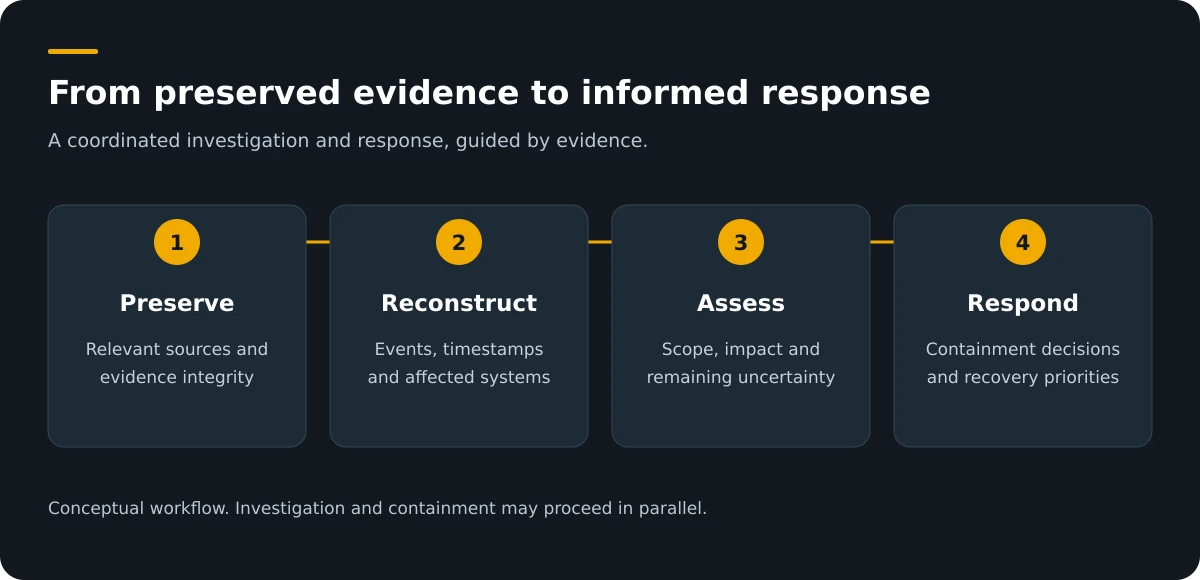
Containment aims to limit further harm. Evidence preservation helps explain what happened and supports later decisions. Business continuity keeps essential work operating where it can be done safely. The response needs to consider all three together.
There is no universal instruction to unplug everything, power down every computer, or wipe a suspicious device. The right action depends on the threat, the affected system, operational dependencies, and what information could be lost. A responder may recommend restricting an account, isolating a particular endpoint, or blocking a specific access path. Those are situation-dependent decisions, not a checklist to apply blindly.
Ask what each proposed change will accomplish, what it could disrupt, and what should be preserved first if circumstances permit. Evidence collection should not become a reason to leave an active, damaging intrusion unchecked. Conversely, a rushed rebuild may make it harder to determine whether the original access path remains open elsewhere.
Have qualified personnel handle evidence collection and technical changes within an agreed scope. Business staff can contribute by preserving their observations and documenting actions already taken, without experimenting on affected systems.
A hypothetical email compromise example
Consider a fictional Houston business whose customer receives a revised invoice with new banking instructions. The salesperson says they did not send it. This example illustrates decision-making, not a real client incident or a platform-specific response procedure.
The coordinator first separates known facts from possibilities. The customer received a message, the payment instructions changed, and the salesperson denies authorizing it. Account compromise is one explanation. A spoofed address or a compromised account elsewhere in the conversation is another.
The business uses a previously verified contact method to tell the customer the payment change is under investigation and should not be relied on. It preserves the original message and relevant invoice information securely. If funds have already moved, the finance lead contacts the financial institution promptly through a trusted channel.
Meanwhile, authorized technical personnel assess available sign-in and mailbox records and look for unauthorized access or changes. They determine whether account restrictions, session revocation, credential changes, or other containment measures are appropriate. A password change alone is not treated as proof that the problem is resolved.
Suppose the review identifies an unauthorized forwarding rule. Removing it addresses one finding. The team still needs to understand its timing, what information may have been exposed, and whether related accounts or access permissions are involved. The business keeps its conclusions provisional where the available records do not answer those questions.
The example shows why the work must run in parallel: protect the payment process, contain unauthorized activity, preserve useful records, and investigate the scope.
Make the first response conversation useful
You do not need a complete diagnosis before asking for help. Prepare a short account of what happened, when it was noticed, and what the business is worried could happen next. Identify the affected services, their business owners, and the person who can approve changes.
Explain what has already been done. Password resets, device restarts, mailbox changes, restored backups, and calls to vendors can all affect the next steps. Reporting those actions honestly is more useful than trying to present a clean or complete story.
Have information about your IT provider, available administrative access, backups, and security tooling ready for discussion. Do not send passwords, recovery codes, or large collections of sensitive files through an unsolicited email or public contact form. Ask for an agreed secure intake method and share only what is needed.
Define recovery before declaring success
A service coming back online is an important milestone, but it does not answer every incident question. Recovery decisions should account for the suspected entry point, unauthorized access that may remain, and the reliability of the systems being returned to use.
Agree on acceptance criteria with the technical team and business owner. What has been validated? What monitoring remains necessary? Which uncertainties are still open? Who can approve restoring access or resuming a sensitive workflow?
After operations stabilize, assign owners to corrective actions and review the response itself. NIST's current incident response guidance, SP 800-61 Revision 3, was published in April 2025 and supersedes Revision 2. It places incident response within broader cybersecurity risk management, connecting preparation with detection, response, and recovery. Read the NIST publication overview.
Get help with the next decision
If your business is dealing with suspicious activity, start with the facts you have and the decisions you need to make. You do not have to label the entire incident before opening that conversation.
Learn about digital forensics and incident response support in Houston from Texas Cyber Solutions. Be ready to describe the affected systems, business impact, and actions already taken so the discussion can focus on an appropriate next step.
For a closer look at how records support findings and where conclusions must stop, read what digital forensics can establish in a business or legal matter.