
A customer list appears outside the company. An employee disputes the reason for a termination. A payment instruction changes inside an email conversation. In each situation, people want an answer to a deceptively simple question: what actually happened?
Digital forensics can help answer that question by examining records from computers, accounts, applications, and other systems. Its value depends on the evidence available, how it was preserved, and whether the conclusions stay within what that evidence supports.
For a Houston business facing a dispute or suspected misuse, the useful starting point is a specific question, not a demand to find something incriminating.
Start with the question you need answered
“Investigate this laptop” gives an examiner much less direction than “Determine whether these project files were transferred from this laptop during the week before the employee left.” The second request identifies a subject, an event, and a time window. It also leaves room for an answer that does not support the original concern.
A well-scoped inquiry can distinguish several questions that initially sound alike. Was a document present? Was it opened? Was a copy created elsewhere? Does the available evidence connect those events to a particular account, device, or person? Each conclusion needs its own support.
Before collection, establish who can authorize access and which systems and records are within scope. When a dispute is involved, coordinate those decisions with counsel rather than assuming possession of a device settles every access question.
Records need context before they become conclusions
A login record identifies activity associated with an account. It does not, by itself, settle who was at the keyboard. A file timestamp can help place an event, but its meaning depends on the system and the operation that created or changed it. A screenshot may capture something important while leaving out the surrounding conversation or underlying metadata.
Examiners therefore compare sources rather than treating one artifact as the whole story. Device records, application activity, and network information may reinforce one another or reveal contradictions. Differences between clocks and time zones must be considered when reconstructing sequence. NIST describes collection, examination, analysis, and reporting as distinct phases of this process in its Guide to Integrating Forensic Techniques into Incident Response, SP 800-86.
For the person commissioning the work, the practical question is: “What else supports that interpretation?” A strong answer explains the connection between the records and the conclusion, including plausible alternatives.
Preservation starts before the examination
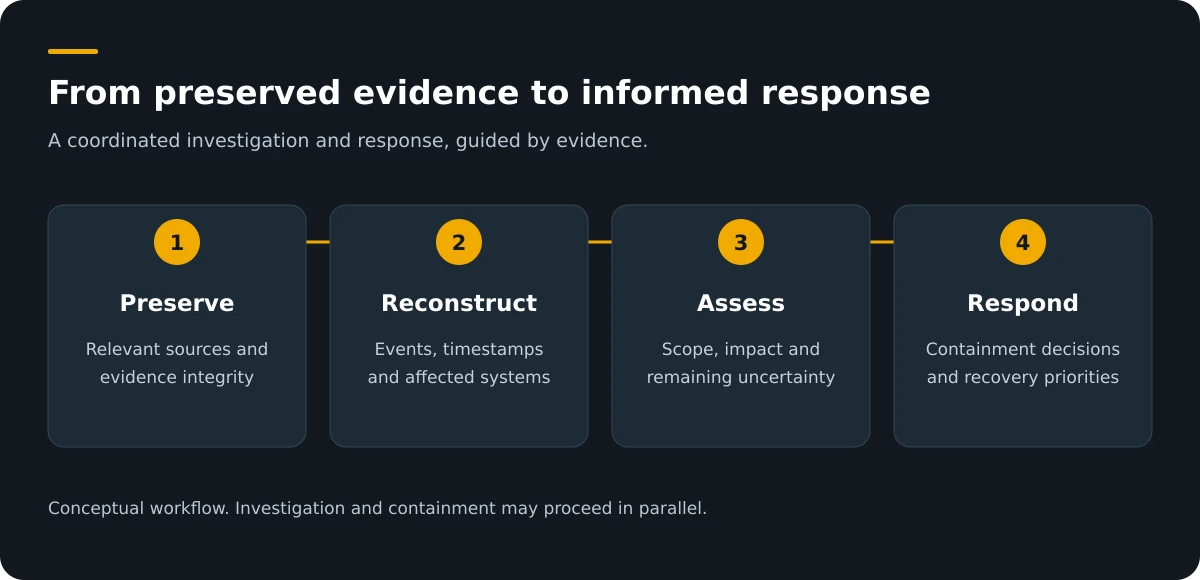
The first person handling a device can affect what remains available. Avoid casually browsing through suspected evidence, installing recovery utilities, or treating a potentially relevant laptop as ready for reassignment. Get case-specific handling guidance rather than applying a blanket instruction to shut down or restart everything.
Preservation includes recording where evidence came from, its condition, who handled it, and what was done. Chain of custody documents possession and transfers. Cryptographic hashes help check whether a collected dataset has changed; they do not establish that every statement inside a file is true.
Live collection can itself change data, which makes documentation important. These principles are addressed in SWGDE's Best Practices for Digital Evidence Collection, version 2.0.
The immediate business decision is who will coordinate preservation. Give that person the initial concern, known devices and accounts, and a record of actions already taken. If someone has already opened files or restarted a machine, say so. Concealing an imperfect first response creates another problem.
A hypothetical example: did someone take the customer list?
Consider a fictional Houston distributor. After a salesperson resigns, management finds a customer spreadsheet on the returned laptop and notices that an external storage device was connected during the salesperson's final week. Management suspects the spreadsheet was copied.
Those two observations justify a closer look. They do not establish the alleged transfer.
Suppose the authorized examination identifies the external device connection, evidence consistent with the spreadsheet being opened, and a local folder used for sales exports. The examiner compares those records with the company's workflow and finds that the sales team routinely produces the same export for an approved reporting process.
At this stage, the report should not describe the routine export as theft. The remaining question is whether evidence connects the particular spreadsheet to the external device or another destination.
Now suppose the relevant external device is unavailable and no retained record identifies a destination copy. The examiner may establish that the device was connected and that the spreadsheet was accessed within the relevant period. The examiner may be unable to establish whether that spreadsheet was copied to that device.
That distinction matters to the next decision. Management can review access controls and ask counsel about further evidence without presenting an unresolved allegation as a technical finding. If additional authorized evidence later becomes available, the conclusion can be revisited.
This hypothetical illustrates why an honest limitation can be more useful than a dramatic answer. The purpose of the examination is to test the concern, including evidence that weakens it.
What a useful forensic report should explain
A decision-maker should be able to follow the report without having to interpret a forensic tool's raw output. Expect a clear statement of the request, the items examined, the methods used, the relevant results, and the basis for any opinions or conclusions. Supporting material should let a qualified reviewer understand how the examiner reached those results.
SWGDE's Requirements for Report Writing in Digital and Multimedia Forensics, version 1.0 distinguishes an examination report from tool-generated supporting material and calls for clear, understandable results and documented bases for opinions.
Ask the examiner to separate direct observations from interpretation and unanswered questions. In the hypothetical above, “an external device was connected” belongs in a different category from “the customer list was copied.” A reader should not have to guess which statement the evidence actually supports.
Know where the answer stops
An examination cannot promise a complete history. Relevant records may be unavailable, outside the authorized scope, or insufficient to distinguish competing explanations. “We did not identify evidence of a transfer in the material examined” is narrower than “no transfer occurred.” Ask which statement the work supports.
Technical findings also do not automatically determine intent, liability, or how evidence will be treated in a proceeding. Those questions need appropriate legal review. No forensic method guarantees admissibility or a particular outcome.
The most useful deliverable is a clear account of what can be established, what remains uncertain, and what additional evidence could resolve the uncertainty. That gives a business or legal team a factual foundation for its next decision.
If you need to define the questions and preservation priorities for a specific matter, see Texas Cyber Solutions' digital forensics and incident response in Houston.
This article provides general educational information, not legal advice.
If suspicious activity may still be ongoing, read what to do when you suspect a business cyber incident for a decision-focused response overview.