Penetration Testing from Texas Cyber Solutions Slams the Door on Attackers
Our Houston-Based Team Finds the Vulnerabilities That Would Disrupt Your Texas Business
Imagine the day when every device in your offices ceases to work and flashes the dreaded words that signal ransomware: DEVICE ENCRYPTED. CALL OUR NUMBER AND PAY OUR RANSOM.
When that day happens, work stops until the hack is defeated or the exorbitant ransom is paid.
Ouch.
That would ruin anyone’s day, and it can happen to any business or organization exposed to the internet.
The only solution is preparation, and the only way to prepare is to hire the best damn hackers in Texas to attack you the way the bad guys do with a penetration test that leaves no stone unturned, no port unscanned, and no system untouched.
Fortunately, Texas Cyber Solutions does just that. Our seasoned team of grizzled, veteran hackers bring elite offensive cybersecurity services in reach of businesses like yours and tests your defenses every which way until the holes in your defenses are painted bright red and are ready for fixing.
Based in Houston, Texas Cyber Solutions tests networks, applications, and cloud environments for Texas businesses with local affinity to the Houston and Harris County areas (We do travel and are ready to serve anywhere in Texas or nearby). You set the scope of the project, and we document where your defenses didn’t hold, so you can prioritize the right fixes. We’ll even help you make the fixes too, unless you’d prefer that your home team handle the defense.
Our team draws on NSA training, military cyber operations experience, and decades of hands-on private sector cybersecurity experience in the most highly regulated industries in the world to test your defenses the same way that the most sophisticated attackers would.
Starting with a full scan of your attack surface (exposure) and then zeroing in on the footholds that lead to what your business can’t afford to lose, our systematic process proves whether an attacker can manipulate your people, pierce your defenses, and commandeer the systems and data that make up the heart, mind, and wallet of your business, as well as when and where your defenses would stop them.
By the end of your penetration test, you’ll know exactly which fixes are needed now to protect your critical operations, and which can wait.
Following your penetration test, you will get detailed reporting and documentation that will alert you to what needs fixing and will certify your integrity towards defending your customers, clients, and assets by detailing our approach and findings, your complete risk, and how what we found relates to your security requirements.
In highly regulated industries, your penetration test report has to stand up to more than a technical review and will be needed by your insurer, regulators, and could even protect your liability following an incident. In acknowledgement of that responsibility, we offer the highest level of service.
Our commitment to you is to make your digital security as bulletproof as possible to attackers, regulators, and more. Reach out today to take your security to the next level and Texas Cyber Solutions will answer your call.
Please keep sensitive details out of the initial inquiry. Our professionals will guide you through the process of initiating your penetration test.
Scope → Test → Explain → Prioritize

On this page
Get The Right Type of Penetration Test for Your Business
Pentests come in many levels of both intensity and scope. Sometimes you need to find out whether your whole organization can take a hit from a determined attacker. Other times you need a thorough examination of a particular app, a specific network or server, or a critical cloud environment.
In the section below, you will learn about the most lifelike and intense testing, which we cybersecurity folks call “red teaming,” as well as more specific tests that focus on a particular need or system.
The test you need is the one that gives you the answers and protection you want.
Red Teaming: Test Your Team Like the Attack is Real
A red team exercise simulates a real cyberattack against an agreed objective. Once we’ve put the scope and ground rules in writing, we start with open-source intelligence (OSINT) tradecraft to study the public online footprints of your organization and its employees. Then we use what we learn to tailor hacking, phishing, social engineering, and even authorized physical intrusion attempts to how your company operates and how your people think and work. The goal is to replicate what a sophisticated attacker would try against your business. Red team engagements combine technical prowess with guile, pretense, detailed study of your company and personnel, and sometimes even impersonating the UPS guy to slip through your defenses.
As the exercise unfolds, we track how far we get, what your employees notice and report, and whether your defenders catch us in time. You’ll see where your defenses stopped us, where we got through, and what needs to change to protect your organization.
A red team engagement is like a penetration test on steroids. You get a full security exercise performed the same way a high-security facility tests its defenses, defenders, and general personnel to identify the real weaknesses that get chained together by attackers in the real world.
Phishing Simulations: Would Your People Call It Out?
The click isn’t the whole story. An authorized phishing simulation shows whether employees spot and report a suspicious message, whether the report reaches the right team, and what happens next. Fix the gaps in training, reporting, and response before a real message puts them to the test.
External Network Penetration Testing: Find Your Exposed Entry Points
Start outside. We test the public-facing systems you put in scope, from remote-access services to internet-facing hosts, and separate what’s merely visible from what could give an attacker a way in. You’ll know which exposures to close first.
Internal Network Penetration Testing: What Can an Intruder Reach?
Start from an agreed point inside the network and see what stands between that access and your critical systems. We test whether permissions and network boundaries contain the damage or let one compromised account put more of the business at risk.
Web Application and API Penetration Testing: Can Users Cross Account Boundaries?
A working login doesn’t mean your data is safe. We test whether the web apps and APIs in scope enforce the rules they’re supposed to: who can see which records, who can take sensitive actions, and whether those boundaries hold across user roles.
Cloud Security Assessments: Find Access That Goes Too Far
An account doesn’t need to be an admin to have too much reach. We examine cloud identities, permissions, and exposed resources to find where access goes beyond what the business intended. We agree up front on whether you need a configuration review, hands-on validation, or both.
Looking for background first? Read our guide to the types of penetration testing.
A Penetration Test Report Your Team Can Act On
A list of vulnerabilities won’t tell you what to fix on Monday. Your penetration test report will. We show what the test proved, what that exposure could cost your operations, and which fixes take priority.
Below the diagram, we break down what your penetration test report includes and why each part matters.
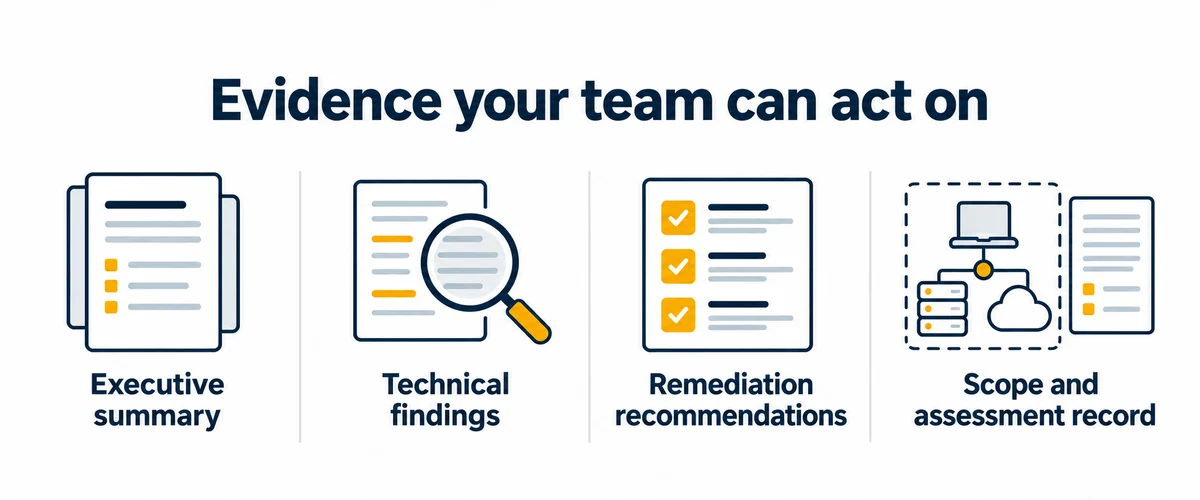
Executive Summary: What’s at Risk and What to Fix First
Your penetration test report opens with an executive summary. It shows what we set out to test, what we found, and what a compromise could mean for your business. Leadership can see which risks demand action first without having to read the technical evidence line by line.
Technical Findings Backed by Evidence
Each technical finding names the affected systems, explains the vulnerability and its severity, and shows the evidence behind it. Your engineers can see what we demonstrated, under what conditions, and where to start the fix. Sensitive details are handled as agreed during scoping.
Remediation: Fix the Cause, Not the Symptom
The remediation section ties each fix to a specific finding and puts the changes that reduce the most business risk first. Your team can assign the work, correct the underlying control, and avoid spending the first week on fixes that won’t protect critical operations.
What We Tested and What Stayed Out of Scope
The assessment record lists the systems we tested, the access we had, the methods we used, and when the work took place. It also spells out exclusions and limits so no one mistakes an untested system for a clean bill of health.
Retesting is available to verify remediation.
What Texas Businesses Should Test First
Texas based businesses, especially those in Houston, Dallas, Austin, or San Antonio, depend on connected systems that extend well beyond the office. A supplier portal, remote-access account or cloud application can connect people, sensitive information and business-critical operations. A useful penetration test follows those relationships and focuses on the consequences of unauthorized access.
Energy and Industrial Suppliers: Put Remote Access to the Test
Evaluate internet-facing services, supplier portals and remote access to corporate systems. Test agreed access boundaries so a compromised account does not quietly become a route to more sensitive resources.
Port, freight and logistics businesses
Examine customer portals, shipment-related applications and authorized integrations. Scope the roles, data and remote connections that support office and warehouse workflows, including access provided to partners.
Healthcare and life sciences
Assess patient-facing or administrative applications, identity controls and cloud permissions around sensitive information. Agree on test accounts, suitable test data and clinical operating constraints before testing begins.
Manufacturing and professional services
Investigate access to business applications, client records and shared files. Test whether account permissions and network boundaries match the access people actually need, including contractors and remote staff.
Plan around operations. These are examples of business priorities, not a blanket testing scope. Corporate IT, industrial control systems, medical devices and other production-sensitive assets require clear boundaries. Safety-critical and production systems are excluded unless separately assessed and explicitly agreed in writing.
What Should Your Penetration Test Find Out?
Could an attacker get in from the internet?
Which public-facing systems could provide an entry point? Start with an accurate asset list and clear ownership, including third-party services that require separate authorization.
If an Attacker Gets In, What Can They Reach?
What could an attacker reach from an agreed foothold? Identify the operational systems, sensitive data and access boundaries that matter most to your business.
Can users cross boundaries in an application?
Can one user access another user’s data or functions reserved for a different role? Define the relevant roles, workflows, integrations and test data, not just the public login screen.
Is cloud access broader than intended?
Could cloud permissions expose sensitive systems or data? Identify the identities, resources and access relationships the assessment needs to examine.
How We Validate Findings and Trace Attack Paths
We check whether individual weaknesses can combine into a larger business risk, then document the evidence and the limits of what the test established.
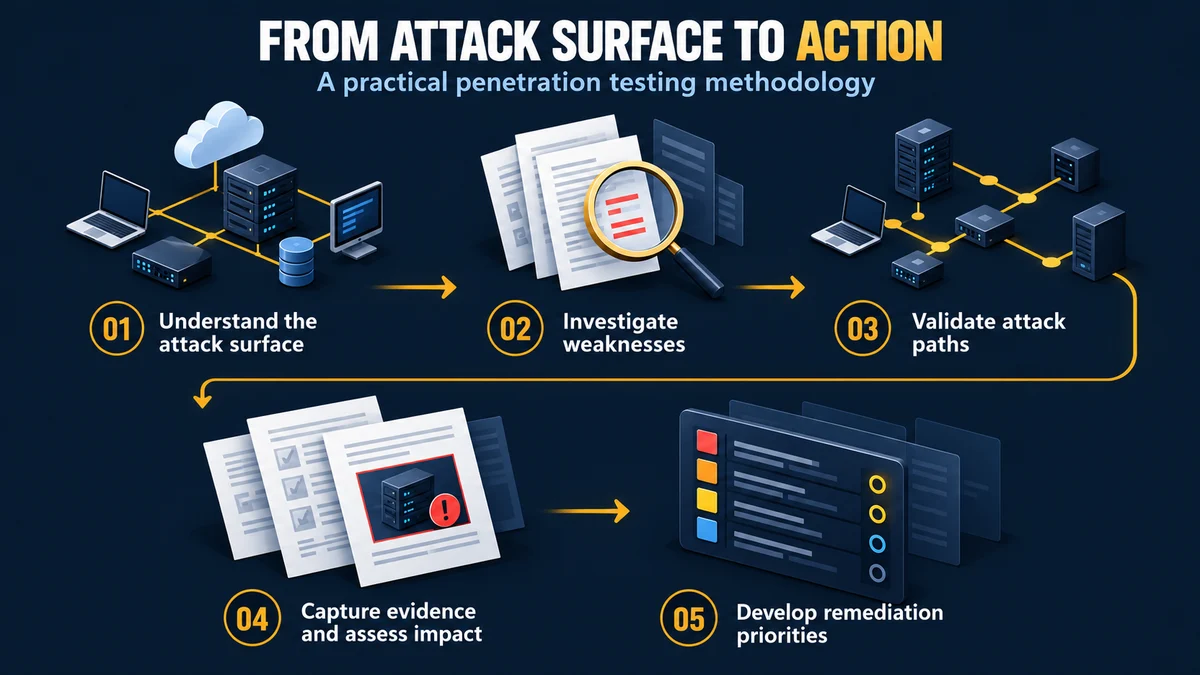
Understand the attack surface
We map in-scope assets, services, interfaces and trust boundaries against the access provided. This establishes what the test can meaningfully evaluate.
Separate Scanner Alerts From Confirmed Vulnerabilities
We examine relevant configurations, exposed services, authentication, authorization and application behavior. Suspected weaknesses are evaluated in context; scanner results are not treated as confirmed findings.
Validate attack paths
Controlled testing establishes whether a weakness is exploitable and what access it permits. Where authorized, we investigate linked weaknesses, stay within agreed boundaries and distinguish demonstrated impact from paths that could not be safely tested.
Capture evidence and assess impact
We document affected assets, conditions and supporting evidence, then assess what the access could mean for your systems and data.
Develop remediation priorities
Recommendations address the underlying weakness and relevant controls. Priorities help technical teams and decision-makers act on the same evidence.
Rules of Engagement: What We Test and What Stays Off-Limits
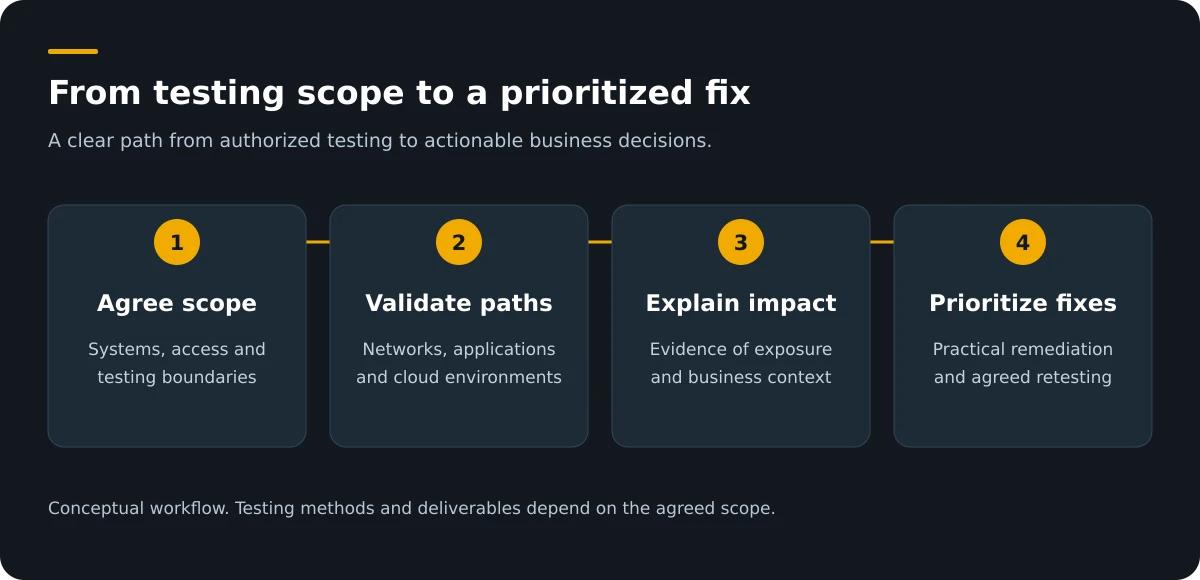
Set the Boundaries Before Testing Starts
We agree on assets, objectives, permitted methods, exclusions, access and testing windows, including operational constraints and who can authorize changes.
Prepare access and communication
Together, we prepare the required accounts, connectivity and test data. We identify contacts for urgent findings or disruption, agree on when testing should pause and record how decisions will be made.
Conduct the assessment
We test within the agreed boundaries, communicate material findings through the agreed process and document limitations affecting coverage or validation.
Deliver findings and next steps
Your report connects findings to affected assets, business exposure and remediation priorities, with detail for technical teams and a clear summary for decision-makers.
Security Testing Standards: NIST, OWASP and More
NIST SP 800-115: Set the Scope Before Testing
Our scoping and reporting approach aligns with the assessment-planning principles in NIST SP 800-115: plan the work, conduct the agreed tests, analyze findings, and develop mitigation recommendations. The engagement defines which techniques are appropriate rather than treating a framework as permission to test everything.
Penetration Testing vs. Vulnerability Scanning
NIST SP 800-53, Revision 5 distinguishes penetration testing in CA-8 from vulnerability monitoring and scanning in RA-5. That distinction matters when deciding whether you need broad vulnerability discovery, exploitability validation, or both. Application scope can also draw on the OWASP Web Security Testing Guide to make coverage explicit.
SOC 2: Agree on the Evidence Your Auditor Needs
Preparing for SOC 2? The AICPA Trust Services Criteria include penetration testing as a possible control-evaluation activity. Testing can support an assurance program, but a pentest is not a SOC 2 examination or a guarantee of a favorable opinion. Agree on the evidence your auditor needs before commissioning the work.
What Affects Cost, Timing, and Preparation
What Drives Penetration Test Cost and Timing?
Asset counts, application complexity, user roles, access preparation, testing restrictions, and reporting requirements all affect the work. Bring your asset list, deadline, and business objective to the first discussion. Scope comes before a meaningful estimate.
Can testing happen remotely?
Internet-facing networks, applications and authorized cloud environments may support remote delivery. Internal access, physical requirements or onsite systems need separate planning. We confirm the arrangements before the engagement.
What should we prepare before testing?
Identify the systems you control, the business question you need answered and the people who can authorize the work. We can then establish access requirements, testing windows, relevant user roles and any sensitive systems that need additional safeguards.
Will a penetration test prove we are secure?
No assessment proves that every weakness has been found. Results reflect the agreed scope, access, methods and testing period. The report should make those limits clear so you can use the findings appropriately.
Turn Test Evidence Into Business Decisions
Why a Vulnerability Score Isn’t Enough
David Taxer, founder of Texas Cyber Solutions, brings together penetration testing, threat modeling and digital investigations with years of experience across insurance, finance, legal services and government. In these high-stakes, highly regulated environments, security decisions need more than a vulnerability score. They need evidence, context and a clear rationale for action.
He is the author of Threat Modeling: The Art of Defensible Decisions, which explores that same challenge: understanding what could go wrong and making informed choices about how to respond.
As an Amazon Associate I earn from qualifying purchases.
Give Engineers a Fix List and Leaders a Decision
For your organization, that means keeping the assessment focused on decisions. Your technical team needs findings it can investigate and remediate. Your leadership needs to understand business exposure and priorities. The goal is to connect both, with clear distinctions between demonstrated impact, remaining uncertainty and the limits of the test.
Let’s scope your penetration test
Bring the Risk and Deadline. We’ll Define the Test.
We’ll use the first conversation to help match the test to the decision you need to make.
Before you contact us: Bring a high-level list of what to test, the business question you need answered, and your deadline. Do not send credentials or sensitive system details.
Prefer to talk? Call 832-271-4477 to discuss your testing scope.