Does Your Company Need a Penetration Test?
Are you wondering which type of penetration testing your company needs?
You’ve come to the right place.
Texas Cyber Solutions has helped aerospace companies, hospitals, oil refineries, banks, insurance companies, defense contractors, and MedTech companies secure digital assets.
In today’s post, I will share my knowledge about penetration testing with you.
Maybe you’ve been tasked with improving your organization’s security posture or are simply trying to understand how to stay one step ahead of cyber threats.
Either way, penetration testing is more than just a technical buzzword; it’s a critical step toward securing your digital landscape.
In this guide, we’ll explore the types of penetration testing, when and why you should consider them, and how to align these tests with your business objectives.
Compliance is also part of the conversation; we’ll touch on it later in the article without bogging you down in dry details before covering essential knowledge. Let’s dive in.
Table of Contents
- Does Your Company Need a Penetration Test?
- Why Penetration Testing Matters
- What Are the Types of Penetration Testing?
- The Penetration Testing Process: A Step-by-Step Breakdown
- Network Penetration Testing: Securing the Backbone
- Wireless Penetration Testing: Closing the Gaps
- Web Application Penetration Testing: Protecting Your Digital Front Door
- Cloud Penetration Testing: Strengthening the Cloud
- API Penetration Testing: Safeguarding Your Endpoints
- Database Penetration Testing: Protecting Your Data Core
- Social Engineering Penetration Testing: Tackling the Human Element
- Physical Penetration Testing: Beyond the Digital Sphere
- API Penetration Testing: Safeguarding Your Endpoints
- Methods of Penetration Testing
- Legal and Ethical Considerations in Penetration Testing
- Emerging Trends and Metrics in Penetration Testing
- The Compliance Angle of Penetration Testing
- Why Choose Texas Cyber Solutions as Your Penetration Testing and Compliance Partner
- Beyond The Basics: The Art of Penetration Testing
- Why Choose Texas Cyber Solutions for Penetration Testing

Why Penetration Testing Matters
Imagine leaving your home unlocked.
It’s an unsettling thought.
Now imagine your IT systems wide open to potential attackers.
That’s where penetration testing comes in.
It’s your proactive measure to identify and secure weaknesses before they’re exploited.
Beyond ticking off a compliance box and running a scan for vulnerabilities, penetration testing equips you with real-world insights into your vulnerabilities and helps you build a stronger defense.
Penetration testing is about thinking like an attacker to protect your organization better.
By simulating potential exploits, it reveals gaps in your defenses and validates the effectiveness of your security controls.
The result?
Actionable recommendations to bolster your organization’s resilience.
What Are the Types of Penetration Testing?
Penetration testing isn’t one-size-fits-all.
Different environments and goals call for different approaches.
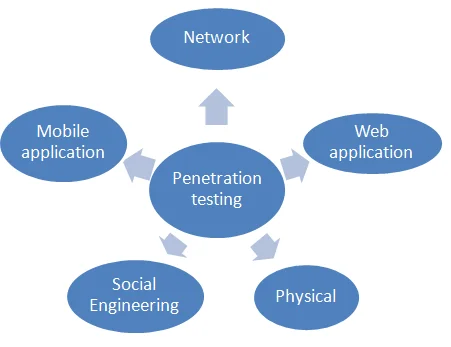
Let’s examine the most common types of penetration testing, such as network, web app, wireless, API, Cloud, physical security, and social engineering, to help you determine which is best for your organization.
The Penetration Testing Process: A Step-by-Step Breakdown
How Is a Penetration Test Conducted?
One of the most common questions we receive is: How does a penetration test actually work?
While each test is unique, every assessment follows a structured, step-by-step process designed to evaluate security risks at multiple levels. The goal is to transform raw data, system insights, and security findings into actionable intelligence.
If you’re not a computer science major, here’s what that means in simple terms: We analyze your security posture from the smallest system details to the big-picture infrastructure risks. This approach ensures that we identify, exploit, and remediate vulnerabilities before attackers can.
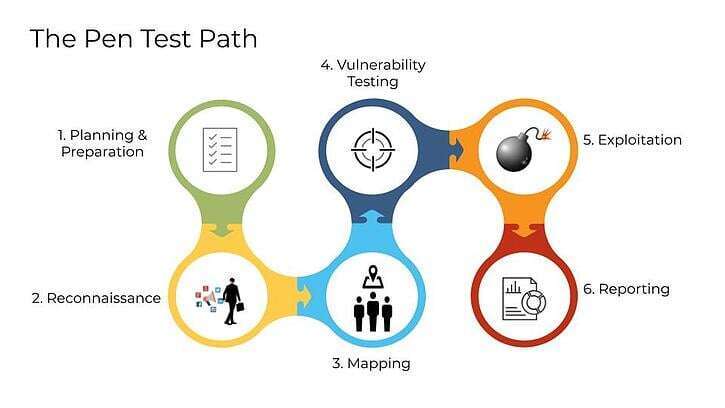
Penetration testing provides a comprehensive, repeatable, and actionable assessment of security weaknesses. Below, we break down the process step by step, integrating industry best practices and relevant frameworks.
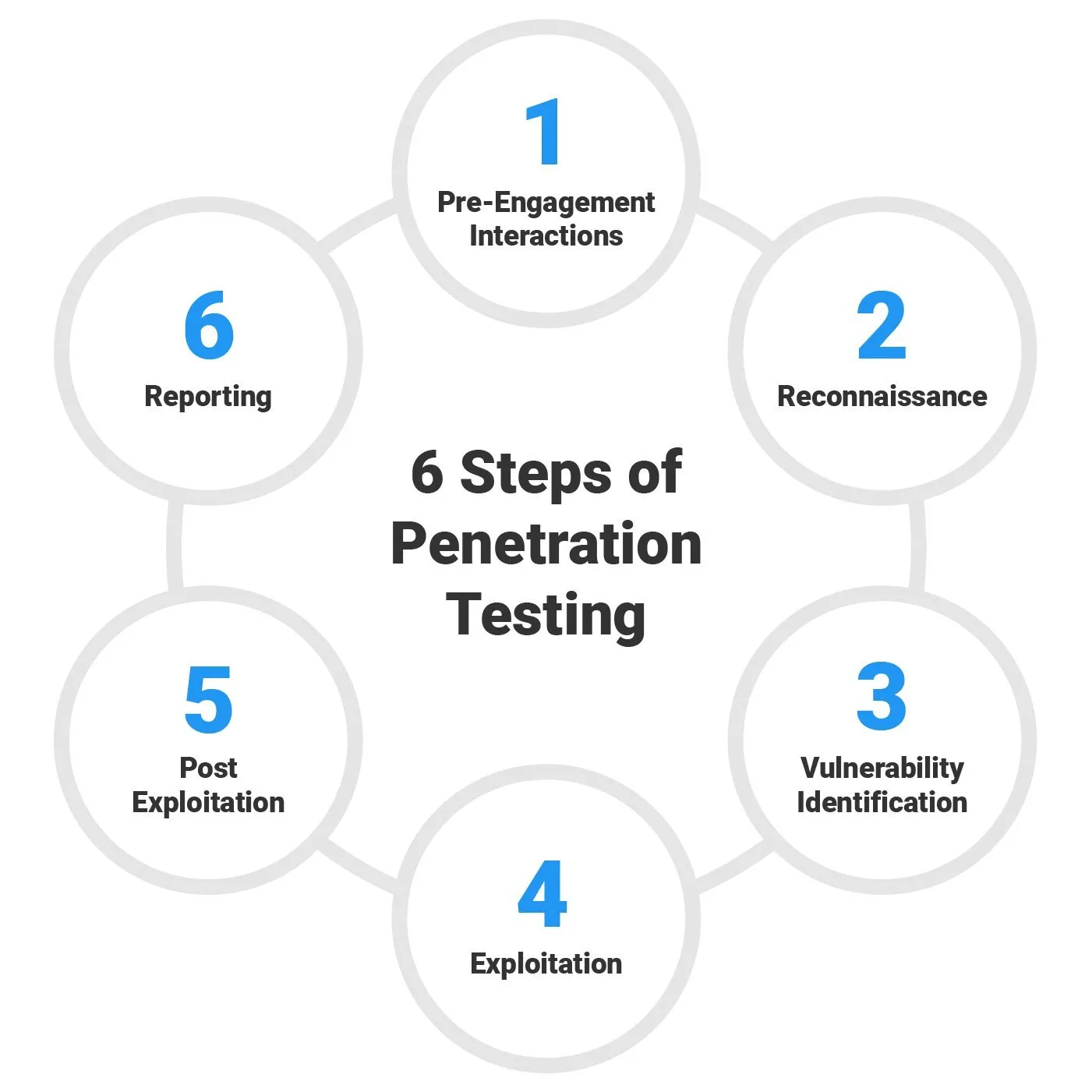
1. Pre-Engagement & Planning
Before testing begins, the scope, objectives, and legal considerations must be clearly defined. This phase ensures the penetration test is strategic, ethical, and effective.
Key Activities:
- Define in-scope assets, such as networks, applications, IoT, or APIs.
- Establish testing objectives for compliance, security validation, or adversarial simulation.
- Select the appropriate testing methodology: black box, gray box, or white box.
- Review legal and compliance requirements, including PCI DSS, HIPAA, GDPR.
Relevant Frameworks:
- NIST 800-115 – Security testing methodologies.
- OWASP Testing Guide – Web application penetration testing.
- PCI DSS 11.3 – Security testing for payment systems.
2. Reconnaissance & Information Gathering
This phase involves gathering intelligence to identify potential attack vectors.
Types of Reconnaissance:
- Passive Reconnaissance – Collects OSINT (Open-Source Intelligence) from WHOIS records, leaked credentials, and public data sources.
- Active Reconnaissance – Engages with the system directly using tools like Nmap, Shodan, and FOCA to map the attack surface.
Relevant Frameworks:
- MITRE ATT&CK – Documents adversarial reconnaissance techniques.
- OSINT Framework – Guides intelligence gathering from public sources.
3. Scanning & Vulnerability Identification
Once reconnaissance is complete, penetration testers actively scan for security weaknesses.
Key Techniques:
- Network Scanning – Identifies open ports, running services, and firewall configurations.
- Web & Application Scanning – Uses Burp Suite, OWASP ZAP, and Nikto to detect vulnerabilities.
- Credential & Privilege Analysis – Tests authentication flaws and privilege escalation paths.
Relevant Frameworks:
- OWASP Top 10 – Common web vulnerabilities.
- CWE/SANS Top 25 – Dangerous software errors.
- NIST 800-53 – Vulnerability management guidelines.
4. Exploitation & Gaining Access
Here, penetration testers attempt to exploit vulnerabilities to determine if an attacker could gain unauthorized access.
Common Exploitation Techniques:
- Exploiting Known Vulnerabilities – Uses Metasploit, manual payloads, or custom scripts.
- Brute Force Attacks – Tests weak passwords and authentication flaws.
- Privilege Escalation – Gains administrative access from a lower privilege user.
- Social Engineering – Phishing, pretexting, or impersonation tactics.
Relevant Frameworks:
- MITRE ATT&CK (Privilege Escalation & Persistence) – Defines techniques attackers use post-compromise.
- C2 Matrix (Red Teaming) – Guides adversarial simulations.
5. Post-Exploitation & Maintaining Access
After gaining access, ethical hackers assess the extent of their control and persistence capabilities.
Post-Exploitation Goals:
- Establish Persistence – Deploy backdoors or maintain session access (when in scope).
- Lateral Movement – Expand control across the internal network.
- Data Exfiltration Simulation – Assess potential for data theft or unauthorized access.
Relevant Frameworks:
- Cyber Kill Chain (Lockheed Martin) – Defines attack progression.
- MITRE ATT&CK (Lateral Movement) – Details how attackers navigate networks.
6. Reporting & Remediation
At the end of the engagement, all findings are documented in a penetration testing report, which includes:
- Executive Summary – Overview of key findings for stakeholders.
- Technical Findings – List of exploited vulnerabilities with proof-of-concept (PoC) exploits.
- Risk Assessment – Categorization of vulnerabilities by severity.
- Remediation Plan – Actionable steps for mitigating security risks.
- Retesting Recommendations – Ensuring fixes are implemented correctly.
Relevant Frameworks:
- PTES (Penetration Testing Execution Standard) – Reporting guidelines.
- ISO/IEC 27001 – Risk management framework.
- NIST 800-115 – Standardized reporting structures.
Why the Penetration Testing Process Matters
A structured penetration testing process ensures organizations:
- Identify vulnerabilities before attackers do.
- Meet regulatory compliance requirements (PCI DSS, HIPAA, GDPR).
- Strengthen incident response and security defenses.
- Reduce risk of data breaches and financial loss.
Network Penetration Testing: Securing the Backbone
Your network forms the core of your organization’s operations, making it a prime target for attackers.
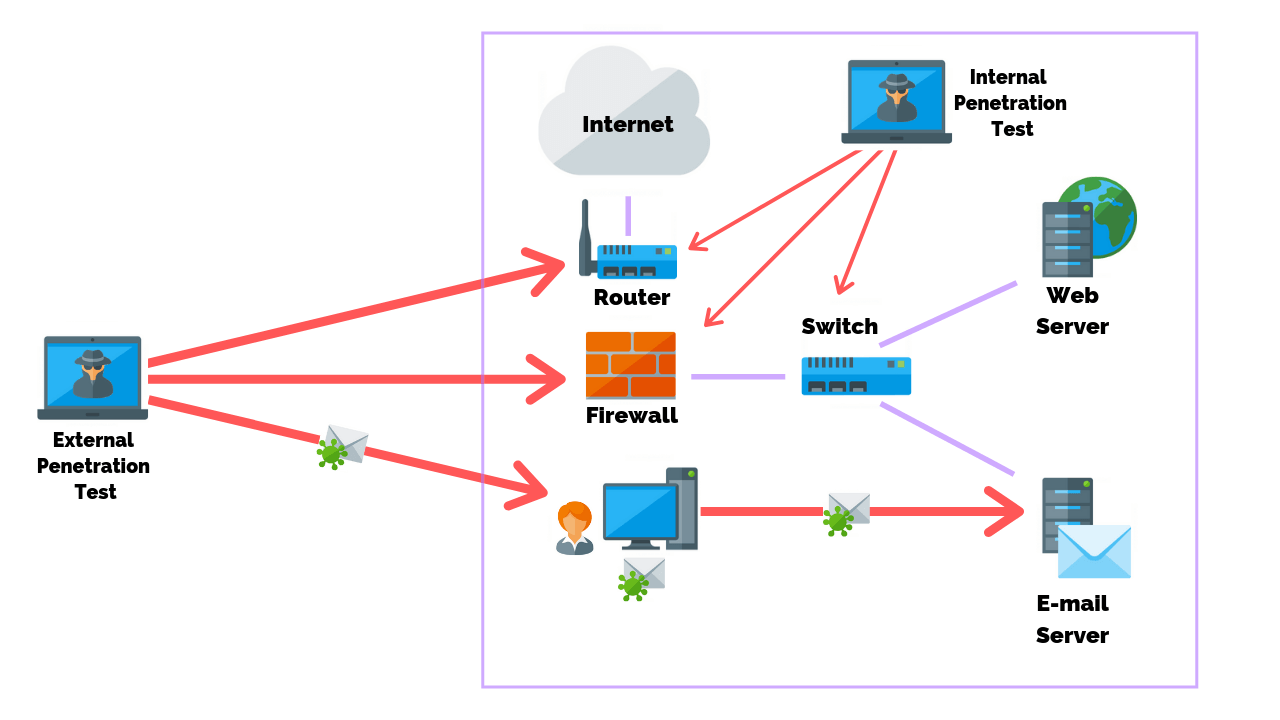
Network penetration testing delves into your network’s architecture and configurations to uncover vulnerabilities that could lead to unauthorized access or data breaches.
With remote work becoming the norm, ensuring network security has never been more critical.
Key Risks in Network Security
- Misconfigurations: Poorly configured firewalls, routers, and switches can open doors for attackers.
- Outdated Systems: Legacy systems often have unpatched vulnerabilities that are easy targets.
- Unsecured Remote Access: VPNs, RDP setups, or home networks may introduce risks when improperly configured.
Methodologies for Network Penetration Testing
- Reconnaissance: Tools like Nmap and Shodan gather information about open ports, services, and connected devices. This phase identifies potential entry points.
- Exploitation: Testers attempt to gain unauthorized access by exploiting identified vulnerabilities using tools like Metasploit or custom scripts.
- Post-Exploitation Analysis: After gaining access, testers assess how far they can move laterally within the network and what data they can exfiltrate.
- Configuration Testing: Evaluates firewall rules, ACLs (Access Control Lists), and segmentation to ensure network zones are appropriately isolated.
Benefits of Network Penetration Testing
Network penetration testing helps organizations address risks and employ robust testing methodologies, building a secure and resilient foundation for their IT operations.
- Proactive Defense: Identifies vulnerabilities in firewalls, routers, and other network components before attackers exploit them.
- Improved Remote Work Security: Ensures secure configurations for hybrid work environments, including home Wi-Fi setups.
- Comprehensive Risk Assessment: This assessment highlights weaknesses across hardware, software, and configurations, providing actionable insights for improvement.
Wireless Penetration Testing: Closing the Gaps
Wireless networks are essential to modern business operations but also represent a significant attack surface.
Wireless penetration testing evaluates the security of Wi-Fi networks and connected devices to prevent unauthorized access and data interception.
Key Risks in Wireless Networks
- Weak Encryption Protocols: Outdated protocols like WEP or weak WPA2 configurations make it easier for attackers to decrypt traffic.
- Rogue Access Points: Unauthorized devices set up to impersonate legitimate networks can trick users into connecting.
- Insufficient Network Segmentation: Lack of separation between guest and internal networks can expose critical systems.
Methodologies for Wireless Testing
- Signal Analysis: Testers use tools like Aircrack-ng to capture and analyze wireless traffic for weak encryption and vulnerable protocols.
- Rogue Access Point Detection: Identifies unauthorized devices broadcasting on your network.
- Authentication Testing: Simulates attacks on WPA2 and WPA3 networks to evaluate the strength of passwords and authentication mechanisms.
- Man-in-the-middle (MITM) Attacks: Test the ability of an attacker to intercept or modify data transmitted over the network.
Benefits of Wireless Penetration Testing
A thorough wireless penetration test strengthens the backbone of your connected environment, safeguarding data and ensuring operational continuity.
Some of the benefits received by pen-testing your wireless network include:
- Improved Network Security: Ensures that only authorized devices can access your corporate or remote worker’s wireless infrastructure.
- Reduced Risk of Data Interception: Identifies and mitigates risks associated with unencrypted or poorly secured communications.
- Compliance Validation: Meets regulatory requirements for wireless security testing.
Web Application Penetration Testing: Protecting Your Digital Front Door
Web applications serve as your organization’s digital face, making them prime targets for cybercriminals.
A comprehensive web application penetration test evaluates everything from authentication mechanisms to data storage and business logic, ensuring attackers cannot exploit vulnerabilities to access sensitive information.
Key Risks in Web Applications
- Injection Attacks: SQL injection, command injection, and similar vulnerabilities can allow attackers to manipulate back-end systems.
- Cross-site scripting (XSS): Enables attackers to execute malicious scripts in the context of other users.
- Authentication and Session Flaws: Weaknesses in login systems, session management, and password storage can lead to account compromise.
- Misconfigured APIs: Improper API configurations may expose sensitive endpoints to unauthorized access.
Methodologies for Web Application Testing
- Static and Dynamic Analysis: Tools like OWASP ZAP and Burp Suite scan applications for vulnerabilities during development and after deployment.
- Business Logic Testing: Testers evaluate workflows to identify flaws in how the application enforces critical processes.
- Parameter Tampering: Testers attempt to bypass access controls or manipulate application behavior by modifying user inputs.
- Custom Payloads: Skilled testers create payloads to test specific vulnerabilities, bypassing WAF protections or exploiting weak input validation.
Benefits of Web Application Penetration Testing
Penetration testing ensures robust defenses against modern threats by focusing on all aspects of your web application’s security.
Benefits include:
- Enhanced User Trust: Secure applications protect user data, building confidence in your services.
- Improved Compliance: Testing ensures adherence to PCI DSS and GDPR.
- Proactive Risk Management: Identifies vulnerabilities before attackers can exploit them.
Mobile Application Penetration Testing: Securing Your Mobile Ecosystem
Mobile applications often serve as gateways to sensitive data, making their security critical. Mobile app penetration testing identifies vulnerabilities in iOS and Android apps, focusing on API calls, data storage, and encryption.
Methodologies
- Static and Dynamic Analysis: Examines code structure and runtime behavior for vulnerabilities.
- API Testing: Evaluates endpoints for authentication flaws, data exposure, and injection vulnerabilities.
- Reverse Engineering: Analyzes apps to uncover hardcoded credentials or insecure code practices.
- Data Storage Testing: Checks for improper storage of sensitive data, such as unencrypted user information.
- Authentication and Session Management: Tests login mechanisms and session handling for security weaknesses.
Benefits
- Enhanced Security Posture: Identifies and resolves vulnerabilities to protect user data and business operations.
- Regulatory Compliance: Ensures adherence to privacy standards like GDPR and CCPA.
- Improved User Trust: Builds confidence in your apps by safeguarding sensitive information.
- Risk Mitigation: Reduces the likelihood of data breaches and unauthorized access.
- Comprehensive Insight: Provides actionable recommendations to strengthen mobile security.
This rigorous testing ensures your mobile applications are resilient against evolving threats while maintaining user trust and compliance.
Cloud Penetration Testing: Strengthening the Cloud
As businesses increasingly migrate to cloud environments, securing these infrastructures is critical.
Cloud penetration testing evaluates your cloud systems’ configurations, APIs, and data flows, ensuring adherence to best practices and robust security.
Key Risks in Cloud Environments
- Misconfigured Storage Buckets: Publicly accessible storage can expose sensitive data.
- Weak IAM (Identity and Access Management): Over-permissioned accounts increase the risk of privilege escalation.
- API Vulnerabilities: Poorly secured APIs can serve as entry points for attackers.
- Shared Responsibility Gaps: Misunderstandings of the shared responsibility model between cloud providers and customers can leave vulnerabilities unaddressed.
Methodologies for Cloud Testing
- Configuration Review: Evaluates storage, IAM roles, and security groups for compliance with security standards.
- API Penetration Testing: Assesses cloud APIs for injection attacks, authentication flaws, and excessive permissions.
- Lateral Movement Simulation: Tests how attackers could move through your cloud environment if one system is compromised.
- Data Exfiltration Testing: Tests for exposed storage buckets, databases, or virtual machines and simulates attempts to export sensitive data undetected.
Benefits of Cloud Penetration Testing
A robust cloud penetration test ensures your environment is fortified against threats while maintaining flexibility and scalability.
- Enhanced Security Posture: Validates cloud configurations against evolving security threats.
- Regulatory Compliance: Ensures adherence to SOC 2, ISO 27001, and GDPR frameworks.
- Improved Visibility: Identifies gaps in your cloud environment and clarifies roles in the shared responsibility model.
- Validates compliance with SOC 2, ISO 27001, or other cloud-specific frameworks.
API Penetration Testing: Safeguarding Your Endpoints
In today’s interconnected digital landscape, APIs are the backbone of modern applications, facilitating seamless communication between systems. However, their ubiquity makes them prime targets for cyberattacks. API penetration testing identifies API endpoints’ vulnerabilities, ensuring these crucial components remain secure and resilient.
Key Risks in APIs
- Broken Authentication: Attackers exploit weak or misconfigured authentication mechanisms to impersonate users or gain unauthorized access.
- Excessive Data Exposure: APIs often expose more data than necessary, increasing the attack surface and risking data breaches.
- Insecure Direct Object References (IDOR): Manipulating object references in API calls can give attackers unauthorized access to data or operations.
- Rate-Limiting Failures: APIs lacking proper rate-limiting controls are vulnerable to brute-force attacks and denial-of-service (DoS) attempts.
- Injection Vulnerabilities: Flaws such as SQL or command injection allow attackers to manipulate API requests and compromise backend systems.
Methodologies for API Penetration Testing
- Authentication and Authorization Testing:
- Simulates attacks to bypass or exploit weak authentication mechanisms.
- Evaluates token management, session expiration, and user roles.
- Injection Testing:
- Identifies vulnerabilities like SQL, XML, and command injection.
- Examines how inputs are sanitized and processed.
- Rate Limiting and Throttling Tests:
- Simulates high-frequency requests to test the API’s ability to prevent abuse.
- Fuzzing:
- Sends malformed or unexpected inputs to identify weaknesses.
- Error Message Analysis:
- Reviews error responses for unintentional data leaks or hints about the system architecture.
Benefits of API Penetration Testing
- Enhanced Security Posture: Secures communication channels and reduces the risk of data breaches.
- Regulatory Compliance: Helps meet GDPR, PCI DSS, and other standards by ensuring APIs follow security best practices.
- Improved Resilience: Protects against evolving threats and maintains the integrity of interconnected systems.
- Actionable Insights: Provides detailed reports with prioritized recommendations for remediation.
Key Tools for API Testing
- Postman: For manual API endpoint testing and monitoring.
- Burp Suite: For automated vulnerability scanning and manual analysis.
- OWASP ZAP: Open-source tool for discovering common vulnerabilities.
- SoapUI: Specialized in testing SOAP and RESTful web services.
- FuzzAPI: For automated fuzz testing of APIs.
By integrating API penetration testing into your security strategy, your organization can proactively address vulnerabilities, ensuring that APIs remain robust and trustworthy while supporting critical business functions.
Database Penetration Testing: Protecting Your Data Core
Databases are the cornerstone of modern businesses, storing sensitive information such as customer data, intellectual property, and financial records. This makes them an attractive target for cyberattacks. Database penetration testing focuses on identifying and addressing vulnerabilities in database systems to ensure critical data’s integrity, confidentiality, and availability.
Key Risks in Database Security
- SQL Injection Attacks: Exploits poor input validation to manipulate database queries, potentially leading to unauthorized data access or modification.
- Weak Authentication Mechanisms: Use of default credentials, weak passwords, or lack of multi-factor authentication increases the likelihood of unauthorized access.
- Excessive Permissions and Privilege Escalation: Misconfigured roles and permissions allow attackers to gain elevated access and control.
- Data Leakage: Misconfigured databases, backups, or logs can expose sensitive information.
- Unpatched Vulnerabilities: Outdated database software with known exploits can compromise the entire system.
Methodologies for Database Penetration Testing
- Credential and Authentication Testing:
- Analyzes password policies, identifies the presence of default credentials, and evaluates multi-factor authentication implementation.
- SQL Injection Testing:
- Simulates injection attacks to discover vulnerabilities that allow unauthorized database access or manipulation.
- Configuration Review:
- Examines database settings, roles, and permissions to identify misconfigurations.
- Privilege Escalation Tests:
- Attempts to exploit improper role configurations to escalate privileges within the database system.
- Data Exfiltration Simulations:
- Tests the ability of an attacker to export sensitive data without detection.
- Backup and Logging Assessment:
- Reviews the security of database backups and logging practices to ensure data integrity and availability.
Benefits of Database Penetration Testing
- Enhanced Data Security: Proactively identifies and mitigates vulnerabilities, ensuring robust protection of sensitive information.
- Regulatory Compliance: Helps meet requirements for frameworks like GDPR, HIPAA, and PCI DSS by validating database security.
- Operational Continuity: Safeguards business-critical data against unauthorized access, corruption, or loss.
- Risk Mitigation: Reduces the risk of data breaches that could damage the organization’s reputation and finances.
Key Tools for Database Penetration Testing
- SQLmap: Automates the detection and exploitation of SQL injection vulnerabilities.
- DbProtect: Provides comprehensive database security assessment and monitoring.
- Metasploit Framework: Facilitates privilege escalation and database-specific exploit testing.
- Nessus: Identifies misconfigurations and vulnerabilities in database environments.
- Burp Suite: Assesses web application and database interactions for security flaws.
Best Practices for Database Security
- Implement strong authentication mechanisms, including password complexity and multi-factor authentication.
- Regularly update and patch database software to address known vulnerabilities.
- Use role-based access control (RBAC) to minimize excessive permissions.
- Encrypt sensitive data both in transit and at rest.
- Perform regular backups and store them securely with proper access controls.
- Conduct periodic penetration testing to identify and address emerging vulnerabilities.
Database penetration testing is an essential component of a robust cybersecurity strategy. By proactively addressing weaknesses, organizations can protect their most valuable assets and maintain trust with customers, partners, and stakeholders.
Social Engineering Penetration Testing: Tackling the Human Element
Cybersecurity isn’t just about technology; it’s about people, too.
Social engineering tests target the human element of your organization’s defenses, simulating various attack scenarios to evaluate and improve readiness.
Humans are inherently vulnerable to manipulation due to evolutionary traits like trust and cooperation, which were once key to survival but now serve as potential weak points in a digital age.
Testing for social engineering resilience identifies gaps in human awareness and the technologies meant to guard against these attacks.
These tests simulate tactics such as:
- Pretexting: Attackers create a fabricated scenario to manipulate employees into revealing sensitive information. For example, pretending to be IT support to gain login credentials.
- Phishing and Spear Phishing: Simulating mass and targeted email attacks designed to trick recipients into providing credentials or clicking malicious links.
- Baiting: Planting USB drives or devices in accessible areas to see if employees use them, potentially compromising systems.
- Tailgating or Piggybacking: Attempting to gain unauthorized physical access by following authorized personnel into secure areas.
- Vishing (Voice Phishing): Using phone calls to impersonate trusted entities like HR or IT departments to extract confidential information.
Each method highlights potential gaps in awareness and provides actionable insights to strengthen training programs and employee vigilance.
By identifying technological shortcomings (like weak spam filters) alongside human vulnerabilities, organizations can build a more comprehensive defense against social engineering attacks.
These insights pave the way for enhanced training programs and technical controls, making resilience a reality.
Physical Penetration Testing: Beyond the Digital Sphere
In today’s interconnected world, it’s easy to overlook physical security in favor of digital protections, but neglecting it can create significant vulnerabilities.
Physical penetration testing evaluates the resilience of your organization’s physical infrastructure against intruders.
It combines technological and procedural assessments to close gaps in your defenses.
Attackers often exploit human complacency or lapses in physical control measures to gain unauthorized access.
For example, an unlocked server room or a poorly monitored loading dock can provide direct access to critical systems.
Testing for physical security resilience focuses on uncovering these vulnerabilities by employing tactics such as:
- Bypassing Locks and Entry Points: Evaluate how easily locks, doors, or windows can be manipulated to gain unauthorized access.
- Cloning Access Badges: Simulates attackers using RFID or NFC cloning devices to replicate employee credentials.
- Disguised Entry Attempts: Assesses whether intruders posing as maintenance staff or delivery personnel can gain access to restricted areas.
- Exploiting Surveillance Blind Spots: Tests for areas where cameras fail to provide coverage or where motion sensors are ineffective.
These tests reveal technological and procedural weaknesses, helping organizations implement better controls like advanced biometric systems, multi-factor authentication for physical access, and comprehensive employee awareness training.
In many cases, improving resilience is as much about fostering a security-conscious culture as it is about deploying robust hardware.
Benefits of Physical Security Penetration Testing Include:
- Assesses the security of server rooms, data centers, and physical access points.
- Exposes vulnerabilities in unmonitored entryways or neglected security protocols.
- Tests employee compliance with physical security policies.
API Penetration Testing: Safeguarding Your Endpoints
APIs power modern digital interactions, connecting everything from mobile apps to cloud services.
However, their pervasive use also makes them a prime target for attackers.
API penetration testing evaluates the security of these endpoints, uncovering vulnerabilities that could compromise your systems or expose sensitive data.
Key risks associated with insecure APIs include:
- Broken Authentication: Attackers exploit weak or misconfigured authentication mechanisms to impersonate users or access restricted functions.
- Insecure Direct Object References (IDOR): Unauthorized users gain access to data or operations by manipulating object references in API calls.
- Excessive Data Exposure: APIs often provide more information than necessary, increasing the attack surface for data breaches.
- Rate-Limiting Failures: Lack of controls allows attackers to overwhelm the API with brute-force or denial-of-service (DoS) attacks.
During API penetration testing, testers use methodologies like:
- Fuzzing: Automated tools send random or malformed inputs to APIs to identify vulnerabilities.
- Authentication Bypass Attempts: Testers simulate attacks to circumvent API authentication mechanisms.
- Injection Testing: This process identifies flaws, such as SQL injection or command injection, that could allow attackers to manipulate back-end systems.
- Error Message Analysis: Reviews error responses to ensure they don’t leak sensitive system details.
Beyond identifying vulnerabilities, API testing evaluates configurations, such as ensuring proper HTTPS usage, implementing CORS policies, and validating input sanitization.
The insights gained help organizations harden API security, reduce data exposure risks, and protect communication between interconnected systems.
- Secures communication between services and user-facing applications.
- Tests for rate-limiting weaknesses that could enable brute-force attacks.
Methods of Penetration Testing
Penetration testing methodologies vary based on the test’s goals, available resources, and the level of information provided to testers. Each approach uncovers vulnerabilities unique to an organization’s security posture.
Key Methodologies Used By Pentesters
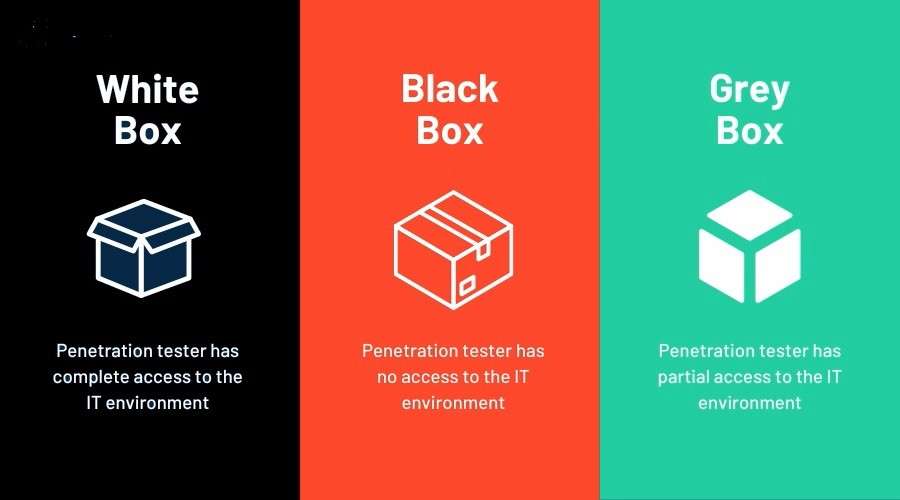
- Black Box Testing: Simulates an external attacker without prior system knowledge. This method assesses external vulnerabilities through reconnaissance and exploitation tools like Nmap and Metasploit. It provides a realistic perspective but may miss internal flaws.
- White Box Testing: Testers have full access to system details, including source code and architecture. This comprehensive approach efficiently uncovers hidden vulnerabilities, making it cost-effective for in-depth analysis.
- Gray Box Testing: A hybrid of black-and-white box testing, this method provides testers with partial system knowledge, such as user credentials or architectural diagrams. It balances depth and realism with cost-effectiveness, effectively simulating insider threats.
- Red Team Engagements: These advanced simulations mimic real-world, multi-vector attacks to evaluate detection and response capabilities. Red teams use tools like Cobalt Strike and custom scripts for comprehensive threat emulation. This approach is suited for mature security programs.
- Continuous Testing: Integrated into DevSecOps workflows, continuous testing uses automation and regular assessments to identify vulnerabilities in evolving environments. It ensures ongoing protection but often requires supplementary manual validation.
- Penetration Testing as a Service (PTaaS): PTaaS employs automated tools for scalable, efficient testing. While suitable for regular vulnerability checks, it lacks the depth and adaptability of manual testing for complex threats.
- Manual Testing with Custom Tools: Human expertise identifies nuanced vulnerabilities beyond automated tools’ reach. Custom scripts and tailored testing approaches provide flexibility for specific environments and unique scenarios.
Cost Considerations of Penetration Testing
The cost of penetration testing depends on methodology, scope, and depth:
- White Box Testing: The most cost-effective option, leveraging full system access for efficient vulnerability identification.
- Gray Box Testing: Moderately priced, requiring additional effort to explore vulnerabilities with partial system knowledge.
- Black Box Testing: More time-intensive and expensive, simulating an external attacker’s perspective with no prior system knowledge.
- Red Team Engagements: The most resource-intensive, involving multi-layered attack simulations and detailed response evaluations.
- Continuous Testing: Priced similarly to gray box testing, it provides regular assessments to secure dynamic environments.
Organizations should align their goals and resources with the appropriate methodology to build a comprehensive defense strategy and address vulnerabilities effectively.
Legal and Ethical Considerations in Penetration Testing
Penetration testing operates within a carefully defined legal and ethical framework to ensure the lawfulness and responsibility of the testing process.
Organizations and testers must address these considerations to maintain trust and avoid unintended consequences.
Legal Responsibilities of a Penetration Tester
- Authorization: Written consent from the organization is mandatory before any testing begins. This includes defining the scope and agreeing on rules of engagement to prevent legal liabilities.
- Adherence to Laws: Testers must comply with regional and global regulations, such as GDPR, CCPA, and specific cybersecurity laws, ensuring no unauthorized data is accessed or exposed.
- Contracts and Agreements: Comprehensive agreements outline tester responsibilities, scope limitations, and liability clauses, protecting both parties.
Ethical Practices for Penetration Testing
- Transparency: Clear communication with stakeholders ensures everyone understands the purpose and limitations of the test.
- Minimizing Impact: Tests are designed to avoid unnecessary disruption to business operations or harm to third-party systems.
- Confidentiality: Testers are bound by non-disclosure agreements (NDAs) to safeguard sensitive information uncovered during testing.
The Importance of Ethical Considerations for Businesses
Addressing these considerations ensures penetration testing aligns with organizational values and regulatory requirements for business leaders, legal advisors, and CISOs.
Proper legal and ethical practices build trust with stakeholders and reinforce the credibility of the testing process.
Emerging Trends and Metrics in Penetration Testing
As cybersecurity evolves, so do the tools, techniques, and methodologies that underpin penetration testing.
Staying ahead requires understanding the latest trends and measuring success through relevant metrics. Here’s what’s shaping the field today:
Emerging Trends Requiring New Penetration Testing Approaches
- AI and Machine Learning: Automated penetration testing solutions leverage AI to identify vulnerabilities more efficiently. Machine learning algorithms analyze patterns from past attacks to predict potential threats.
- Attack Surface Management (ASM): Organizations are adopting ASM tools to continuously map and monitor their expanding attack surfaces, especially with the proliferation of IoT devices and remote work setups.
- Cloud-Native Testing: As businesses migrate to the cloud, penetration tests increasingly focus on cloud-specific vulnerabilities, such as misconfigurations in serverless architectures or insecure APIs.
- Integration with DevSecOps: Continuous penetration testing is being integrated into CI/CD pipelines, enabling organizations to identify vulnerabilities during development.
- Zero Trust Assessments: With the shift toward zero trust architectures, penetration testing now includes validating strict identity verification and access controls.
Key Metrics to Measure A Pentest’s Success
- Vulnerabilities Identified: The number and severity of vulnerabilities uncovered during a penetration test provide a snapshot of the organization’s security posture.
- Time to Remediation: Measures how quickly identified vulnerabilities are addressed, reflecting the organization’s agility in responding to risks.
- Post-Remediation Resilience: Tracks the effectiveness of fixes by conducting follow-up tests to ensure vulnerabilities are no longer exploitable.Cost Savings: Evaluate the potential savings from avoided breaches, downtime, and compliance fines due to proactive penetration testing.
- Employee Awareness Improvements: For social engineering tests, metrics like phishing simulation success rates indicate the effectiveness of employee training programs.
Why These Trends and Metrics Matter
Understanding these emerging trends ensures penetration testing remains relevant and impactful for business leaders, CISOs, and technical teams.
Metrics provide tangible proof of improvement, helping justify investments in security and guiding future initiatives.
Organizations can build a dynamic defense against evolving threats by embracing innovation and measuring success.
The Compliance Angle of Penetration Testing
Compliance is more than a regulatory necessity for business leaders, legal advisors, and CISOs.
It’s a cornerstone of organizational trust and operational resilience.
Frameworks like PCI DSS, HIPAA, ISO 27001, and GDPR establish baseline security standards to protect sensitive data and critical infrastructure.
However, achieving and maintaining compliance requires a strategic approach integrating security best practices with organizational goals.
Why Compliance Matters
Compliance isn’t just about avoiding penalties; it’s about safeguarding your reputation and demonstrating a commitment to protecting customer data.
Regulatory breaches can result in hefty fines, legal challenges, and loss of customer trust.
Penetration testing helps organizations align with these requirements by:
- Identifying vulnerabilities that could lead to non-compliance.
- Providing documented evidence of proactive security measures.
- Supporting incident response readiness in alignment with regulatory expectations.
Bespoke Compliance Testing
Every organization operates within unique regulatory landscapes. For example:
- Financial Institutions: PCI DSS mandates annual penetration testing to protect payment card data.
- Healthcare Providers: HIPAA emphasizes regular risk assessments, including penetration testing, to secure patient records.
- Global Enterprises: ISO 27001 requires a risk-based approach to information security, where penetration testing validates the effectiveness of controls.
Tailored penetration tests ensure that specific compliance requirements are met without compromising operational efficiency. This means mitigating risks for CISOs and legal advisors while meeting audit expectations.
The Strategic Role of Compliance
Compliance isn’t a one-time activity—it’s an ongoing process that evolves with emerging threats and regulatory updates.
Penetration testing provides a roadmap for continuous improvement by:
- Highlighting gaps in existing controls.
- Offering insights into emerging threats that may impact compliance.
- Enabling proactive adjustments to policies and procedures.
Why Choose Texas Cyber Solutions as Your Penetration Testing and Compliance Partner
When it comes to penetration testing and compliance, choosing the right partner can make all the difference.
Texas Cyber Solutions is a trusted, holistic security partner that offers unparalleled expertise and a tailored approach to your organization’s unique challenges.
Texas Cyber Solutions: Your Compliance Partner
At Texas Cyber Solutions, we specialize in aligning penetration testing with regulatory frameworks to ensure compliance and enhanced security.
Our comprehensive reports provide actionable insights tailored to your industry’s standards, empowering business leaders to make informed decisions.
With a focus on reliability, expertise, and adaptability, Texas Cyber Solutions helps organizations turn compliance into a competitive advantage.
Penetration testing isn’t just a checkbox for compliance; it’s a proactive measure that keeps your organization secure in an evolving threat landscape.
By understanding the types of penetration testing and aligning them with your business needs, you’re not just defending against attacks—you’re building a security culture.
Ready to secure your organization?
Partner with experienced penetration testers who understand the nuances of modern threats and can turn vulnerabilities into opportunities for growth.
Your security journey starts now with the assistance of Texas Cyber Solutions’ penetration testing and compliance experts.
Benefits of Partnering with Texas Cyber Solutions
- Comprehensive Expertise: With a team of seasoned professionals experienced across industries, Texas Cyber Solutions ensures no vulnerability is overlooked. Whether you operate in finance, healthcare, or technology, our industry-specific insights elevate your security posture.
- Customized Solutions: We understand that cybersecurity is not a one-size-fits-all issue. Our approach is tailored to meet your needs and align with your operational goals and compliance requirements.
- Holistic Approach: Security isn’t just about patching vulnerabilities and building resilience. Texas Cyber Solutions offers end-to-end services integrating penetration testing, compliance management, and strategic guidance to fortify your organization.
- Proactive Collaboration: As your long-term security partner, we work alongside your teams to foster a culture of continuous improvement and awareness, ensuring that security becomes an integral part of your business processes.
Why a Texas-Based Trusted Partner Matters
Organizations face evolving threats that demand more than isolated solutions, and our 100% Houston, Texas team will ensure that you have a trusted partner throughout your security journey. We will never outsource your security, and God forbid, in your darkest hour, we will be there to help you in person.
A trusted partner like Texas Cyber Solutions offers:
- Integrated Defense Strategies: Combining technical, procedural, and compliance-focused solutions for comprehensive protection.
- Simplified Compliance: Expertise in navigating complex regulatory landscapes ensures your organization remains compliant without unnecessary complexity.
- Enhanced Trust: Demonstrating a robust security framework builds confidence with clients, partners, and stakeholders.
Choosing Texas Cyber Solutions means more than addressing today’s vulnerabilities; it’s preparing your organization for tomorrow’s challenges by partnering with an elite team of cybersecurity professionals homegrown in Houston.
Beyond The Basics: The Art of Penetration Testing
Penetration testing transcends mere technical assessment; it embodies a strategic art form where ethical hackers emulate potential adversaries to uncover and address vulnerabilities before they can be exploited.
This proactive approach identifies weaknesses and provides a comprehensive understanding of potential attack vectors, enabling organizations to fortify their defenses effectively.
The Strategic Value of Penetration Testing
- Holistic Vulnerability Identification: By simulating real-world attack scenarios, penetration testing reveals technical and human vulnerabilities, offering a complete picture of an organization’s security posture.
- Actionable Remediation Insights: Detailed reports from penetration tests provide prioritized recommendations, guiding organizations in effectively addressing identified weaknesses.
- Enhanced Incident Response Preparedness: Understanding potential attack paths enables organizations to refine their incident response strategies, ensuring swift and practical reactions to real threats.
- Integration with Threat Modeling: Penetration testing complements threat modeling by validating identified threats and attack paths, ensuring a comprehensive risk assessment and mitigation approach.
- Regulatory Compliance Support: Penetration testing helps organizations meet industry standards and legal requirements, demonstrating proactive measures to protect sensitive data and systems.
Why Choose Texas Cyber Solutions for Penetration Testing
At Texas Cyber Solutions, we pride ourselves on delivering tailored penetration testing services that align with your organization’s security needs.
Our team of seasoned professionals employs advanced methodologies to ensure thorough assessments.
- Proven Expertise Across Industries: Our extensive experience spans sectors including Houston’s most critical infrastructure, including aerospace, oil and gas, healthcare, and financial services, ensuring we understand and can address industry-specific security challenges.
- Client-Centric Approach: We prioritize building strong client relationships, ensuring our services are customized to meet your specific requirements and objectives. Our clients are our neighbors, and so are your customers. Protecting you and your clients is our duty as professionals and good neighbors.
- Commitment to Excellence: Our dedication to delivering high-quality services has earned us a reputation for reliability and effectiveness in cybersecurity. Our management team has a collective 45 years of experience securing critical infrastructure and has presented research at over 40 major conferences ranging from HouSecCon to ShellCon.
Partnering with Texas Cyber Solutions means entrusting your organization’s security to professionals committed to safeguarding your digital assets with precision and care.
Let us help you transform potential vulnerabilities into strengths, ensuring a robust and resilient security posture.

Written By:
David Taxer is the founder of Texas Cyber Solutions, combining an attacker’s mindset with an investigator’s eye for evidence. His work spans penetration testing, security architecture, digital forensics and open-source intelligence, connecting technical weaknesses with the human behavior and business decisions behind them. Quoted by KHOU 11 and featured on Fraudish and The Hacker’s Cache, David writes about how attacks unfold, what the evidence reveals, and how organizations can build stronger defenses.